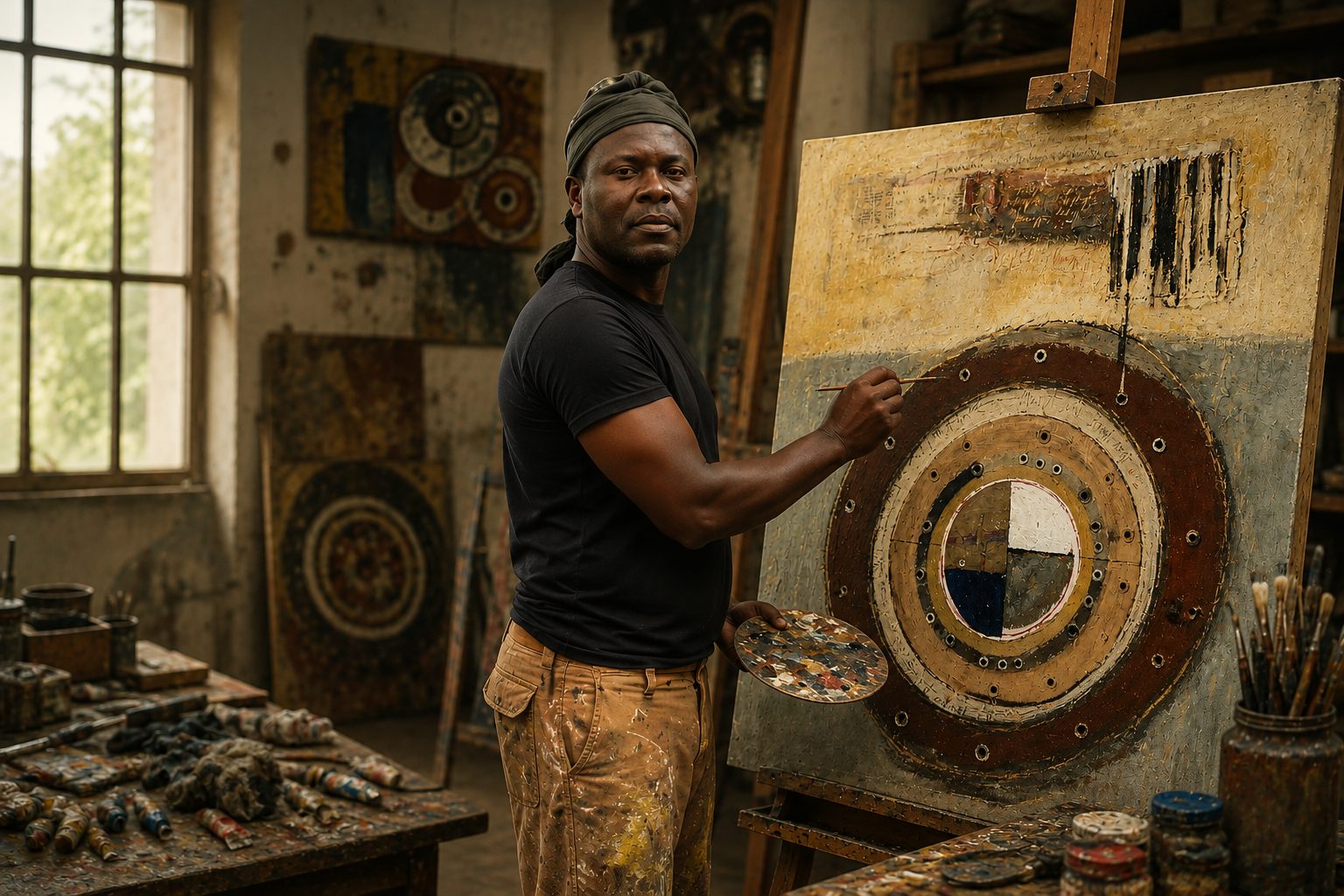
Bethel Aniaku in his studio, working on a circular composition. Photograph from the artist's archive.
Timeline
- 1970Born in Lomé, Togo, on July 4.
- 1990Returns to Lomé and commits to abstraction as his mode of expression.
- 1994First recognition: an award in a national visual-art competition, and a first group exhibition at Festival Ewolé, Lomé.
- 2002Exhibits at the Assemblée Nationale in Paris; selected among 100 artists worldwide for a World Cup exhibition spanning Tokyo and Seoul.
- 2003Fourth solo appearance in Europe; exhibits and lectures at the Théâtre de l'Olivier, Istres, France.
- 2005First solo exhibition in the United States, at the Mbari Institute, Washington, D.C.
- 2006–07Solo exhibitions in Bordeaux and Brussels, including a show at the European Commission.
- 2009Group exhibitions in Atlanta (a homage to Martin Luther King) and at the French Embassy in Washington, D.C.
- 2012"Instinct of Desire," solo exhibition, Parish Gallery, Georgetown, Washington, D.C. — reviewed in The Washington Post.
- TodayContinues to paint and exhibit between Togo, France and the United States.
Group Exhibitions
- 1995"Afro-European Inspiration," Pédakondji, Togo.
- 1996Chinese Cultural Center, Cotonou, Benin.
- 1996International Salon of Visual Art, Hôtel Mercure Sarakawa, Lomé, Togo.
- 1997Festival des Arts de la Rue (FAR), Grand Bassam, Côte d'Ivoire.
- 1998Allad'Art, Allada, Benin.
- 2000"Atelier Jardin de Sculpture," Goethe-Institut, Lomé, Togo.
- 2001"Le Chemin du Partage," La Rochelle, France.
- 2001"L'École de Lomé," Luxembourg.
- 2002"Les Grands et les Jeunes d'Aujourd'hui," Assemblée Nationale, Paris, France.
- 2002Selected among 100 artists worldwide for the World Cup exhibition, Tokyo, Japan, and Seoul, South Korea.
- 2009Homage to Martin Luther King, Art Space International, Atlanta, USA.
- 2009French Embassy, for "Francophonie," Washington, D.C., USA.
Solo Exhibitions
- 2000"Inspired by Intuition," French Cultural Center, Lomé, Togo.
- 2001German Embassy, Lomé, Togo.
- 2001Galerie du Médoc, Bordeaux, France.
- 2002Kyffausortr Gallery, Berlin, Germany.
- 2002Gesamtverband des Einzelhandels, Berlin, Germany.
- 2003Théâtre de l'Olivier, Istres, France.
- 2005Mbari Institute, Washington, D.C., USA.
- 2006Château Bourran, Bordeaux, France.
- 2006Espace Amalgama, Brussels, Belgium.
- 2007European Commission, Brussels, Belgium.
- 2007Château Dillon, France.
Awards & Recognitions
- 1994Fourth-position award, national visual-art competition organized by C.O.E., an Italian organization based in Barzio, Lomé, Togo.
- 1999Sixth-position award, visual-art competition organized by PACIPE (environmental protection agency), Lomé, Togo.
- 2002Honor guest at Documenta de Kassel, hosted by the German Embassy, Lomé, Togo.
- 2002Issa Kouyaté Award, 6th edition of Festival Ewolé, Lomé, Togo.
Collections
- JapanContemporary Art Museum of Hiroshima.
- JapanTokyo Museum.
- SenegalBCEAO — Central Bank of West African States, Dakar.
- USASmithsonian Institution, Washington, D.C.
